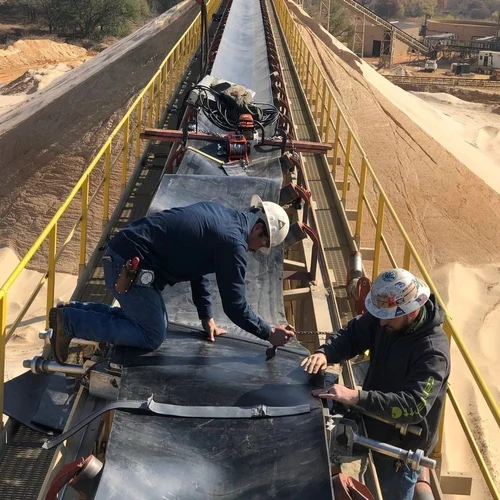
On site belt jointing_

On site belt jointing_

  • On-site belt jointing (or splicing) is the process of joining two ends of a conveyor belt together directly on the structural conveyor frame.
    • Hot Vulcanisation: Uses heat, pressure, and raw rubber strips in a specialized press to chemically bond the belt ends. It creates the strongest, smoothest, and longest-lasting joint, making it ideal for high-tension steel-cord or heavy fabric belts.
    • Cold Vulcanisation: Uses chemical bonding agents and specialized adhesives to fuse the stepped ends of fabric belts together at ambient temperatures. It requires no heavy heating presses, making it cost-effective for medium-duty belts, but requires curing time.
    • Mechanical Fastening: Uses metal staples, rivets, or bolts to mechanically clamp the belt ends together. It is the fastest method for emergency repairs and requires minimal training, but creates a rigid joint that can wear down pulleys and scrapers.
Enquiry Now
On site pulley lagging

On site pulley lagging

  • Pulley lagging is the process of applying a protective, high-friction layer or coating to the shell of a conveyor pulley while it remains mounted on the system.
    • Purpose: It eliminates belt slippage by increasing the friction coefficient, sheds water and debris from the system, and protects the metal pulley shell from premature abrasive wear
    • Materials: Usually utilizes grooved rubber sheets (diamond or herringbone patterns) for standard drive pulleys, or ceramic tile-embedded rubber strips for extreme-tension, wet, or muddy environments.
    • Application Method: The metal surface is ground clean and primed on-site. Specialized cold-bonding industrial adhesives are applied to permanently fuse the lagging strips directly onto the pulley without dismantling the conveyor structure.
Enquiry Now
Maintenance of conveyor belt_

Maintenance of conveyor belt_

  • Conveyor belt maintenance involves a scheduled mix of inspections and adjustments to maximize the service life of the belt and prevent catastrophic system downtime.
    • Daily Tracking & Alignment: Monitoring and adjusting idlers to ensure the belt runs dead-centre. Misalignment causes edge fraying, structural damage, and material spillage.
    • Component Inspection: Checking for frozen or seized idlers, worn-out impact cradles, and damaged pulley lagging that can score or cut the moving belt.
    • Tension & Cleaner Management: Maintaining proper counterweight or take-up tension to prevent belt slippage, and adjusting scrapers/cleaners to remove sticky material carryback that causes tracking issues.
    • Damage Control: Routinely inspecting the top rubber cover for deep cuts, gouges, or damaged joints, and applying immediate cold patch repairs to prevent water or moisture from rotting the internal fabric carcass.
Enquiry Now

Are You Ready to Move Forward?

If you possess a strong work ethic, a passion for industrial engineering, and a commitment to operational excellence, we want to hear from you. Explore our open positions and submit your application today at info@souryaconveyor.com Join us, and let’s keep the world moving forward together

Join Our Team
ENQUIRE NOW
WP Icon